
First things first, Happy New Year! I hope Santa brought all of you something fun and in tune with the Zeitgeist, like this chap! I’m just glad that I will be spared from watching The Polar Express repeatedly for at least another year.
The “joy” of trade data is that it’s very easy to construct a “good news – bad news” style-comment. The “good news” associated with falling imports and rising exports is that the US trade deficit shrank. The bad news is that lower demand for imports is usually evidence that domestic consumers have been priced out of something. With all due respect to the great State of Wisconsin, my kids strongly prefer Italian Parmesan to the Wisconsin version. It’s not even close (yes, I have tried the cheap stuff on them). Import substitution can always be viewed through glass-half empty or half full prisms. For example, the always excellent Tedeschi focuses here on the price level impact of tariffs, while admitting that the inflation consequences depend on both the impact on aggregate demand and the Fed’s reaction function. Similarly, Gita Gopinath and Brent Neiman.
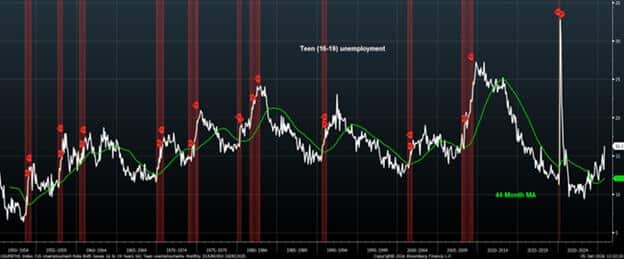
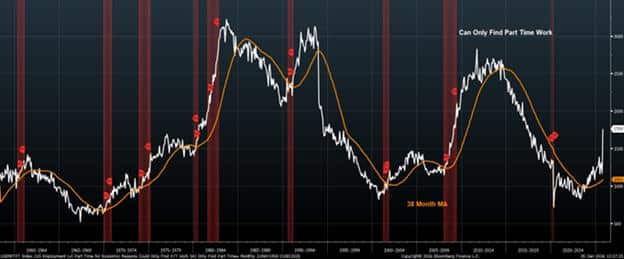
I’m a bond guy, so my glass is generally half-empty, but it’s easy to understand why some might see the latest trade data as a positive economic development. If nothing else, GDP arithmetic means that Q4 ’25 GDP will come in much hotter than previously expected. In contrast, my thoughts pivoted immediately to the effective tariff rate and whether this was further evidence that the lower leg of the “K” is struggling right now. Reasonable observers might argue that the jury is still out, but some of the recent evidence has been far from comforting. So far, the post-shutdown data has shown rising U3 and U6 unemployment, soft job openings and hiring, and cooling wage growth. Teen employment or those seeking work who can only find part-time employment, both look rather ominous. Weakness in these employment sub-categories is consistent with evidence of developing weakness at the household level, which in turn is consistent with falling imports. I said I was prone to seeing glasses as half-empty, but a “Wyley E Coyote scenario” does sound quite bad.
Teen employment!!
Can only find part-time work.
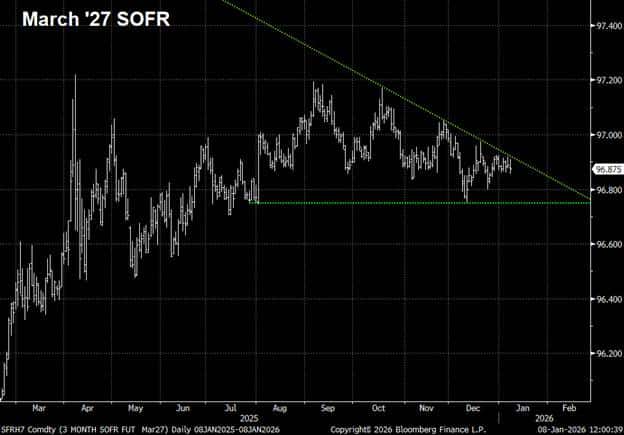
When life hands you lemons, you are meant to make lemonade. So, I am watching this chart quite closely. My suspicion is that this will break on the upside, but it would be a mistake to jump the gun. We never know what we don’t know, something that Swiss Intelligence (and Gillian Tett) were kind enough to remind us about recently. What I do know (from grim experience) is that cognitive biases can be very expensive, to paraphrase a quote that is erroneously attributed to Mark Twain.
It’s not just US importers who have been having trouble finding buyers recently. Jeff Snider shares my rather pessimistic take on US credit markets. Another prism for viewing current account trade deficits is as capital account surpluses, one way or another. Big trade deficits have been very easy for the US to finance, even with an expensive dollar, because foreign investors have been very keen to buy the US’s global data and AI franchises, aka the “Mag 7”. It’s not like our European allies/partners have any competitor companies. But if we are to have smaller global capital flows going forward, who will finance the less attractive corners of US credit markets and on what terms? I suppose the Trump administration probably has a plan to address this, but it’s worth remembering what Mike Tyson said about plans and that not all politicians are entirely reliable. Would it really be so strange if the future were a little different from the recent past?