
It can’t be much fun being Federal Reserve Chair these days. As is the case for many of the 72-year-olds who greet us at Walmart, Jerome Powell must be asking himself why he is still working. But in Powell’s case, it’s not because his retirement savings are insufficient for his needs. Not that we can read his mind, but we suspect Powell shows up to work because he feels a debt of loyalty to both the institution and its staff, and leaving now would put the institution firmly in the hands of the WH. Whether that’s good or bad depends on your political views, but it is clear that the senior staff at the Fed think it would be bad.
What makes the job so hard is not just the backseat driving from the President, but the polarisation of the Board (itself a function of differences of opinion with the WH about appropriate monetary policy). As it happened, Powell navigated the process of consensus-building (often like herding cats) better than expected. The only dissent came from Miran, who appears particularly zealous in agreeing with the President on monetary policy. Powell characterised the cut as a “risk management” cut in the Q&A, where the risks were to the employment side of the mandate. There is an obvious joke about whose jobs might be at risk, but we will refrain from making it (for once).
Several commentators noted the apparent contradictions inherent in the voting and the “dot plot“. Anna Wong pointed out that the median growth forecast had increased and the UR projection was lowered for ’26 and ’27, but Powell told us that downside risks to employment had increased(!?). A fair percentage of Fin Twit decided to play the game of “guess who’s dot”: No prizes for guessing Stephen Miran’s dot, but there was a fair amount of spec on who thought rates should be on hold/hiked?
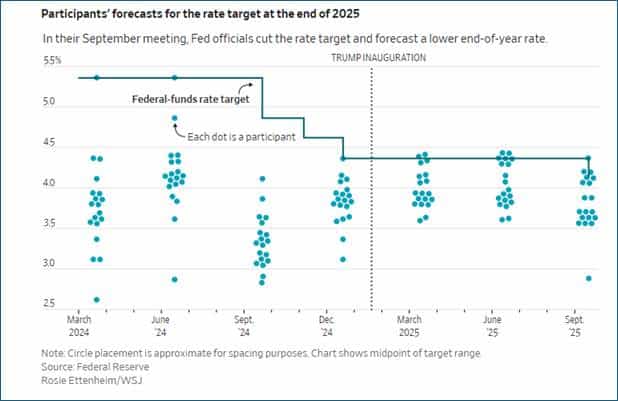
Truth be told, the Fed meeting was a bit of a bore. Bonds sold off on the fact, having fully priced the rumour: the only excitement surrounding the questions of how many dissents and what rationale Powell could find for the cut. We found the coverage of the Tricolor failure far more interesting. Not because we think it presages a GFC-style credit collapse (although auto-loan delinquencies are quite high), but rather because of what it might be telling us about the scale of prior migration into the US, and the impact of the ICE crackdown on illegal immigration. The FT had a couple of good articles about the story, and one paragraph in particular caught our eye.
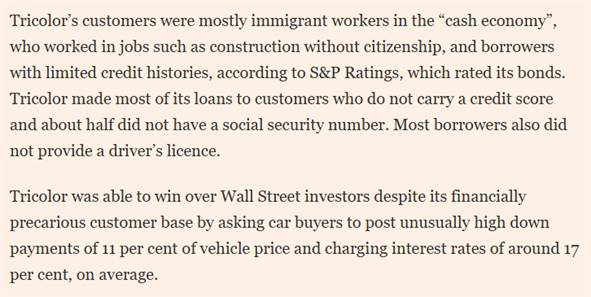
Regular readers will know we are keen disciples of William of Ockham, and just as some can’t resist a pretty face, we struggle to resist a parsimonious explanation for observable phenomena. In this case, illegal immigration might explain a lot about the curious resilience of the used auto market and the buoyancy of the gig economy. We hope to return to this theme later because it’s certainly not the only symptom of ICE’s high efficacy. Moreover, the hypothesis has testable and tradable implications for gig economy companies and stocks like $CVNA.


