
Last week, we asked whether Lisa Cook was “cooked”. The question is important because if Cook is forced to leave the Board of Governors, the WH would be able to appoint another Trump loyalist, giving it effective control over who is reappointed among the regional Fed Presidents and therefore the FOMC. We will admit to being puzzled by the widespread notion that Trump does not have a legitimate interest in either Fed policy or staff, or that interference in Fed “independence” was “unprecedented”. Sure, Central Bankers or Trump’s political opponents (those sets may intersect) may think Fed independence sacrosanct, but historically, that claim does not ring true. Neither is Fed independence is any guarantee of good policymaking: the Fed does have a track record. It’s as if there is an unspoken doctrine of Central Banker infallibility, should the monetary and fiscal authorities’ policies be inconsistent.
That doesn’t mean we are unaware of some of the consequences of Trump’s power play: indeed, there is plenty of circumstantial evidence that the markets have a very good idea where WH policy might lead. But (forgive the repetition) it does not serve the interests of macro investors to worry too much about the rights and wrongs of a policy: our objective is profitability, not probity. Put another way, don’t hate the playa, hate the game. One might say the same about the DoJ opening a criminal investigation into Lisa Cook. Still, at least they didn’t sic the IRS on her. Yet.
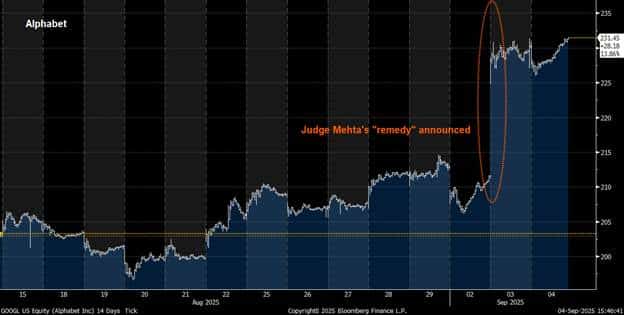
Which brings us to the recent remedy announcement in the important Google antitrust trial. Last year, Judge Mehta found against Google, writing that “Google is a monopolist, and it has acted as one to maintain its monopoly. It has violated Section 2 of the Sherman Act.” Understandably, this ruling had a chilling effect on Google’s stock price performance, because the market feared that the judge might require the breakup of Google’s monopoly, as mandated by the law. That’s not what Judge Mehta decided. Dan Ives described Mehta’s ruling as “a monster win for Cupertino, and for Google, it’s a home run ruling that removes a huge overhang on the stock.” Indeed!
Of course, it’s hard to please all the people all the time, and Matt Stoller took the decision very hard (hence this week’s title). He was not alone. We were struck by Stoller’s emotional capitulation.
“We are in a pre-crisis moment. There is no stopping the bubbles and predatory behavior. It can be modified slightly, perhaps, but really, there is only preparing for the crash and hoping it’s not as horrible as it probably will be.”
It’s not that we disagree, but we thought everyone knew that there’s no crying in the casino.
It’s possible the remedy will be appealed, although we wouldn’t suggest holding your breath: Trump’s DoJ has other priorities. But we raise the situation not just because Alphabet is one of the key drivers of stock market performance, but because corporate margins have been so important in driving stocks higher, and oligopolistic markets (pricing power) have been an important part of this. Google’s ability to extract economic rents has been critical to both its stock price and the outperformance of the “Mag 7”. And that’s without considering how those profits can create a short-term boost for stock prices when they are used to fund stock buybacks.
While the corporate sector seems to be doing just fine, the situation is a little different for the household sector. There is some evidence of labor market softening, and with any luck, we will get a cleaner read with this week’s NFP data, but the most recent data is consistent with some slowdown. The question is how much?