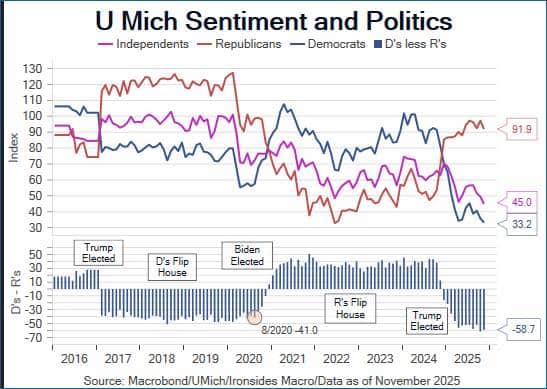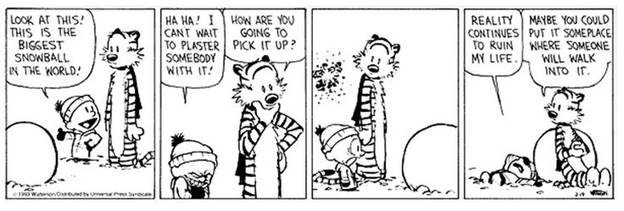
Doctors, economists and politicians occasionally suggest that we should “Treat the disease, not the symptoms”. Apparently, the phrase originated with Andrew Taylor Still, the founder of osteopathic medicine, who emphasized treating the underlying causes of illness, rather than just alleviating symptoms. Still expressed this with the rather wonderful, “To find health should be the object of the doctor. Anyone can find disease.”
Of course, for economists of politicians, the distinction between symptom and disease is metaphorical. In economics, it can be quite difficult to pin down what is “symptom” and what is “disease”. Often, the distinction is in the eye of the beholder and conditioned by their personal interests.
Take Zohran Mamdani’s recent NYC electoral win. Should we consider the election of a “democratic socialist”, and according to some, a radical Islamist and communist (a pretty unusual combination), a symptom or the disease? We would suggest symptom and, unironically, we would suggest it’s a symptom of much the same underlying disease which elected Trump: the erosion in the standard of living of middle- and working-class Americans. We are not alone in thinking this, and there are other formulations of the same broad idea. Of course, Mamdani and Trump suggest very different policy “prescriptions” but that’s because they have different diagnoses (not to mention very different political bases to pander to). But it is interesting to consider the peculiar strength of feeling that both Mandani and Trump manage to generate among their opponents. What explains it? Some have accused us of cynicism (nous!?), but if asked to venture a guess why Mamdani provokes such strong feelings, we would suggest Mamdani’s base might disproportionately feature renters over owners, and that we feel strongly about our property values too.
Regardless, Mandani seems to have a keen eye for a photo opp. Which is why we tend to agree with this chap regarding where to place Mamdani ideologically. We were particularly struck by Lina Khan popping up on Mamdani’s transition team as Lina did great work at the FTC (CEOs of oligopolistic companies may disagree with us on this), but it was probably too little, too late for American consumers suffering Covid-era “Greedflation”. We say that despite knowing that there are sensible people who dispute even the concept of “greedflation”, just as there are sensible people (including us!) who dispute the notion of “class war”. We prefer to think in terms of interests.
Turning to another example of confusion between symptom and disease, we couldn’t help but notice the fallen angel index had set a new record for the decade. Probably just the destruction part of Schumpeterian “Creative Destruction”. But a good clinician should consider all symptoms in reaching a diagnosis.
Do these “symptoms” suggest a specific course of “treatment” for thoughtful investors? In this question, we defer to Apollo’s Marc Rowan, who was kind enough to share some of his thoughts in their recent earnings call.
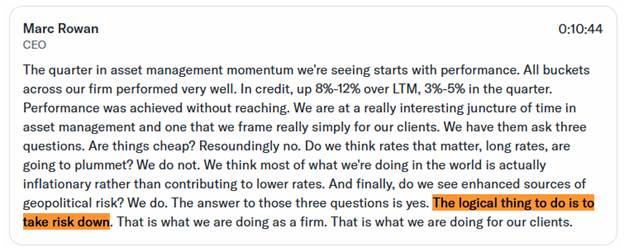
Which begs the question, what happens if everyone decides that they agree with Mr. Rowan and tries to “take risk down” too? If everyone takes their risk down at once, someone somewhere will struggle to roll over their debt.
To avoid the risk of selective quoting, it’s worth including his subsequent paragraph to avoid gerrymandering his words. He was certainly not negative about Apollo’s business prospects.
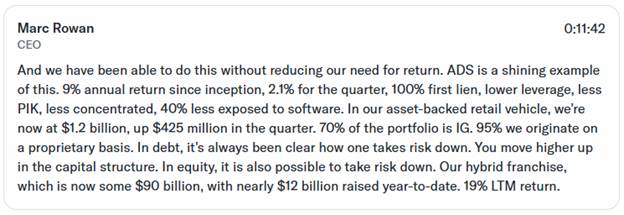
Given our cynicism problem, you won’t be surprised if we ask why borrowers were prepared to accept these terms?
Returning to the symptom vs disease metaphor, does Rowan’s recommendation address the disease or just its symptoms? We suggest symptoms. Not that it’s very helpful to make this observation at this point, but the underlying disease might have been something that Rowan’s business shares some culpability in. Hardly proof, but some suggest First Brands was a “case study in the perils of covenant-lite lending”
It’s unhelpful to focus on the question of fault rather than the appropriate “cure”. In credit markets, some might suggest that the problem was covenant-lite lending. In the case of electing democratic socialists to high (low?) office, some might suggest that part of the problem lies in Trump’s attempted economic cure. This seems to be what a Zeitgeist comment in this week’s BoA’s Flow Show was suggesting.

I suspect the Zeitgeist comment is correct, but it’s also less helpful than one might hope. The Republicans still need to win the midterms. In the circumstances, it’s hard to imagine an alternative to Trump’s “run it hot” policy. Perhaps the only viable choice is more cowbell.