
I spent some time in Wisconsin last week (yes, it was cold), with a group of investors swapping ideas (and terrible jokes). The invite was particularly useful for me because I don’t get out much – suburban basements may not be so different to Socrates’ “caves”. Some of the presentations helped confirm some of my priors (which is valuable), while others challenged my thinking (which is even more valuable). But I found one presentation from an equity manager (h/t Chip) particularly useful because its simplicity clarified something obvious but not explicit. The Trump administration’s policies have ALL been broadly stock market supportive, with the exception of tariffs.
You, dear reader, might quite reasonably say “no sh*t, Sherlock”. But seeing it laid out so simply made everything a little clearer for me. Tariffs are the cornerstone of this administration’s policy, because “reshoring” is its core policy, although it’s probably a bipartisan policy objective. The problem is that such a policy is not broadly consistent with healthy stock market returns or improving standards of living, so its negative effects need to be offset. What is particularly striking is the consistency and focus this WH has brought to its policy. I would argue that the Trump administration has pulled EVERY stimulative policy lever it has access to.
Of course, no matter how aggressive the Trump administration is, it can never match the Biden administration’s Covid-driven fiscal policy! Now that’s how you do “shock and awe”! But it was a pandemic, and pretty much every Western political leader made the same (gross errors of?) judgment call.
Let’s take a quick survey of the WH’s policy initiatives. I know you have been following the WH’s monetary policy “debate” with the Fed. But beyond that, we have –
- Fiscal policy: will add roughly 0.5% over 2026 but front-loaded to Q1.
- Prudential Supervision: relaxed the supervisory environment and announced it will reduce heacount by 30%, just to make sure!
- Tax policy: extended or made certain allowances (accelerated depreciation) permanent.
- Deregulation: “Unleashing prosperity through deregulation”. Worth noting that they also created an “Investment Accelerator” via executive action to fast-track large investments and coordinate approvals.
- Competition policy: Relaxing FTC and FCC competition policy to facilitate M&A.
- UST Debt management: Following Janet in shifting issuance towards the front end, the trend remains your friend with respect to the average maturity of the debt.
- And let’s not forget the coming proposals to improve housing affordability. $200bn is close to a year’s mortgage production, and trial balloons have been floated on mortgage portability (sorry, MBS owners), among other ideas.
- And most recently, we could point to US fx policy.
Why have I bored you with all this? Well, it’s because POTUS has finally picked a new Fed chair and markets think he made a (comparatively) hawkish choice. Anna Wong had a particularly popular take on this. Far be it for me to contradict Anna, who is generally a good call on matters macro, but I struggle to believe that Warsh is going to be significantly more hawkish on inflation than other candidates. I think the administration has already amply demonstrated its conviction that US productivity growth will remain elevated, and that policymakers shouldn’t be too worried about inflation over the medium term.
That said, there were signs that we might have had too much of a good thing of late. Yes, a lower dollar is a good thing, as the President said, but perhaps the rate of change was unacceptably fast. You don’t boil frogs if you turn the heat up too high cos they will jump out of the pot.

There was definitely some evidence that dollar weakness (and, dare I say, tariffs?) might have had some impact on short-term inflation expectations.
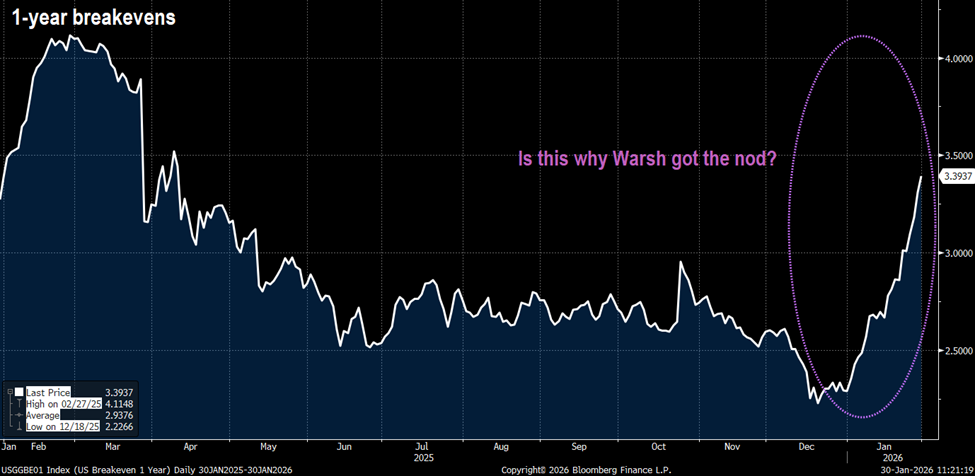
So perhaps Warsh was a tactical choice, designed to rein in the idea that the dollar is a one-way bet. We now have a FOMC Chair in-waiting who will (ostensibly) prioritise reducing inflation and bringing down the Fed’s balance sheet, if we rely on his past public statements. And perhaps that will be enough to bring mortgage rates down.
But I can’t help but think that those two objectives are inconsistent without certain other actions to encourage private sector balance sheet growth to take the place of the Fed balance sheet (specifically a steeper curve). I struggle with the idea that the WH will pivot on tactics and strategy. Their track record is pretty clear, and so is the underlying logic of their policy mix. So I will treat Warsh’s appointment as the exception that proves the Trump rule. I expect monetary policy will remain surprisingly accommodative, despite the nomination of what many seem to think is an inflation hawk as the next Fed chair. And I would expect private sector monetary growth to be at least as fast as any Fed balance sheet contraction.