It’s been an incredibly interesting news week for those of us who focus on the nexus of markets and politics. This publication is often a little self-indulgent because it aims to read (and sometimes write) between the lines on recent financial/economic/political events. That’s precisely why we enjoy writing it! But first off, a little comedy. Blue Owl demonstrated the joy of unintentional irony by suffering a run on its Blue Owl Capital Corporation II. Readers may recall Jamie Dimon’s comments on pest control: “When you see one cockroach, there are probably more”. At the time, we were curious about Blue Owl’s co-CEO Marc Lipshultz’s evident irritation with Dimon’s remarks (described aptly as sly jabs in one piece); “an odd kind of fear-mongering” and “I guess he’s saying there might be a lot more cockroaches at JPMorgan.” Well, now we know. Blue Owl has experienced redemption requests that exceeded the quarterly liquidity it offered its investors. The fund proposed a deal where investors in the open-ended (untraded) fund would be merged with its closed end fund. Unfortunately, the closed end fund trades at a 20% discount to NAV, which didn’t exactly entice investors in the smaller open fund. The net effect was a sharp drop in Blue Owl’s stock price, which resulted in management scrapping the proposed merger and going back to the drawing board. Good luck with that.
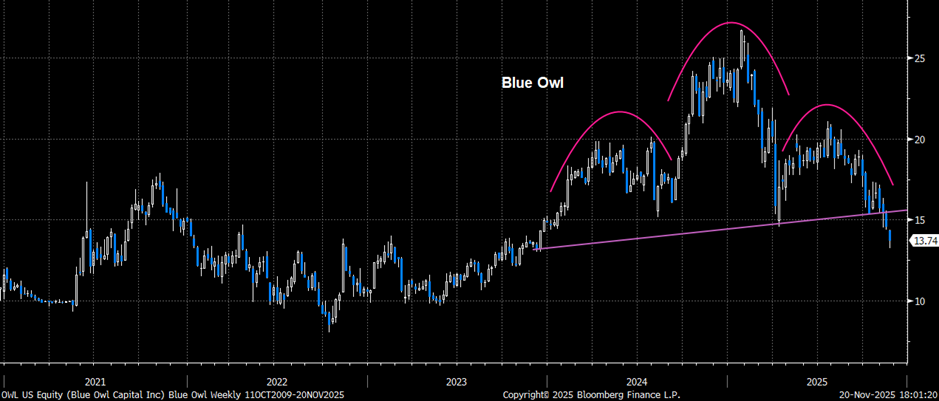
We were intrigued by Blue Owl’s exposure to Data Centers, which the always excellent Matt Stoller wrote about. There is a lot of money going into data centers right now, and it might well be a great trade, ultimately. After all, we are told the investors are very smart. But the scale of the investment is striking, and it’s not particularly surprising that some are asking questions about the ultimate profitability of these investments. It is, however, ironic that an AI (Bloomberg’s) appears to have asked some of the more pertinent questions. We are unsure whether this is bullish or bearish for AI plays.
There are all sorts of observations one could make about this being a new era. We agree, but perhaps for different reasons than others. Larry Summers announced that he is stepping back from public life after some of his email exchanges with Jeffrey Epstein were released by the House Oversight Committee. Summers was reported to have described himself as “deeply ashamed” of his actions. Our question is, which actions? After all, Summers and his friends (past and present) have been at the center of a whole series of late 20th century disasters which have redistributed income and wealth from many to the few. This has been popular with the few: less so the many.
Matt Stoller (again!) pointed out something I had missed: Summers and Jeff Sachs did their PhDs together at Harvard, under the tutelage of the same PhD supervisor. Indeed, they both became the youngest professors ever to win tenure at Harvard on the same day. These guys and their buddy, Olivier Blanchard, were marked down for greatness!
Let’s briefly review some of their work. Summers was a key proponent and architect of the repeal of the Glass-Steagall Act in the late 1990s. As Deputy Treasury Secretary and then Treasury Secretary under President Bill Clinton, he actively advocated for financial deregulation, which culminated in the passage of the Gramm-Leach-Bliley Act of 1999. Repealing Glass-Steagall wasn’t the only cause of the GFC, but one could argue that it did facilitate it. You might also say the same about Summers blocking Brooksley Born from extending regulation into the OTC markets. Lack of regulation didn’t create the GFC, but it did make it possible.
Larry and his buddy Jeff did some of their most significant work in Russia. Some of us spent time in Russia in the 90s and are familiar with their work. Sachs was involved with something called the Harvard Institute for International Development, serving as its director from 1995 to 1999. Sachs is considered the author of “shock therapy,” a term he disliked and did not coin. It has been described as a rapid, comprehensive, and far-reaching program of reforms aimed at transitioning an economy to a market system. Sadly, it is hard to make an omelet without breaking eggs. One of its side effects is impoverishing the country, transitioning and redistributing its wealth to a small group of politically connected insiders. You might start to see a pattern in the work of both Summers and Sachs.
How was Summers involved? Well, the two Harvard professors on the ground in Moscow, Andrei Shleifer and Jonathan Hay, were found to have made personal investments in Russia while leading the US-funded economic transition program. Harvard received $40 million to provide “impartial” advice. Unsurprisingly, the US government sued Harvard, Shleifer, and Hay (forgive me, I couldn’t resist) for $120 million under the False Claims Act (triple damages), and a Federal Judge found Shleifer and Hay liable for conspiring to defraud the US government. Summers, a close personal friend of Shleifer, reportedly intervened to ensure that Shleifer faced no disciplinary action, and Harvard agreed to pay $26.5 million to the US government to resolve the lawsuit. Shleifer paid $2 million.
One might go on to say that despite his brilliance as a neoclassical economist, Summers was an awful swaps trader, but to his credit, he never allowed this to stop him from making money. Some men can rise above their disabilities. He held a number of Board positions, including (and this is where we come full circle) including at OpenAI.
The late Richard Medley, who once employed several MI2 Partners, knew Professor Summers well and occasionally offered us his thoughts, which might partially explain why we were not entirely surprised by recent events. But if Larry really is leaving public life, it will be the end of an era. We shall see.



0 comments